You must log in or # to comment.
This isn’t philosophy anymore, it’s just game theory
it’s interdisciplinary.
Not even. Game Theory is supposed to take a lot of stuff into account. Boiling it down to this is insulting and a way to paint situations like proxy wars as immoral.
This feels too high quality for a shit post.
Gotta make sure your fiber intake is decent so you get good quality shit like this
If these are tracks in the US then I just understaff the engineers and maintenance teams and the train derails before I have to make a decision, checkmate.
If these tracks are in the US, so I am. So I shoot the other guy with the gun(s) I usually carry around when I go out and then pull the lever.
wow what an excellent day in the neighbourhood
i sure hope I won’t be faced with an ethical dilemma in the very near future
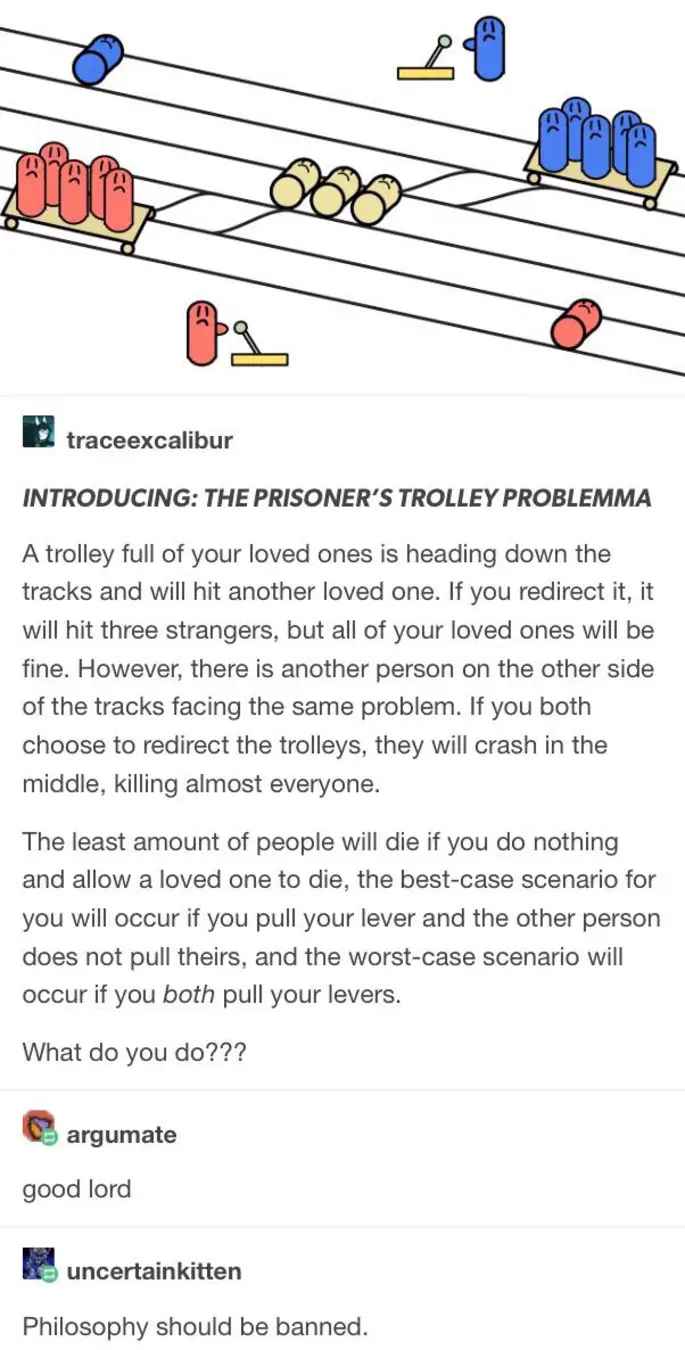
This is only superficially a prisoner’s dilemma. In a true one, you cannot get a better result for yourself no matter what the other person does, but here if you assume the other person pulled the lever, there is no reason to pull the lever yourself.
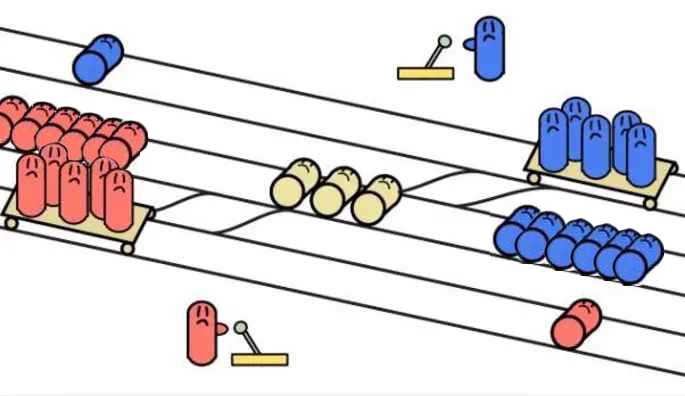
To fix this, you can have 4 relatives on the trolley, and 5 of the opposite faction way back on the middle track. Both do nothing, 1 relative of each is killed. One guy switches the lever, their relatives are all fine, other guy loses 5. Both switch, crash with all 8 relatives on the trolley dead.
I see what you’re trying to do and you’re not necessarily wrong, but you’re kinda perpetuating the attitude that inspired someone to make this meme in the first place
I’m not sure I follow. Should this meme’s creator not have been inspired?
Touche. But no, my point was more of a haphazard reflection on how both the Trolley Problem and Prisoner’s Dilemma are (by design) built on the idea of reducing human life and/or morality and empathy down to a math problem. It is a method of thought that has its purposes, sure, but I think too many people make that their default setting, which makes dehumanization more common, even if subconsciously. Idk man, I’m going through some stuff
Edit: Fixed a pretty bad typo
Given that this problem is given during corporate interviews … it probably screens for the requisite level of sociopathy.
Unlike the classic prisoners dilemma, this isn’t a nash equilibrium. When I know that the other person pulls their switch, I’d improve my outcome by not pulling mine. Compare to the prisoners dilemma, where not snitching when the other side snitches earns you five years in prison.
for the longest time, i did know that game theory did not have anything to do with “games” and that it is somehow connected to the prisoners dilemma, but the concept as such wasn’t very clear to me. If you are like my former me, take 30 minutes out of your day and visit https://ncase.me/trust/ to learn and play around with game theory; it’s a great webpage and it’s pretty good fun all around.
I did a few game theory simulations in college and they were always real interesting. In one of them for example, it was a multiplayer game, with multiple interactions. I think it was to simulate global trade basically: you could cooperate with as many players as you want and each time you cooperate you both get a point. If you defect then you get two and they get none. However, all the players could see what the other players are doing, so if you defected they would know and probably would play (trade) with you. The best way to win was to form as many connections as possible and fully cooperate the whole time.
I formed maybe like 20-30 connections with other players and didn’t defect. Each point was worth a few cents or something. So I walked out with a check for like $20-$50 or something. Many players walked out with nothing because they cheated too many people too many times and nobody wanted to trade with them.
Therefore, clearly, the best economic policy is protectionism, tariffs, trade wars, and fucking over both allies and enemies, right? Right?!?
Your simulation seems to only punish selfish actors when that’s not always the case. Doesn’t include natural monopolies, lacks clandestine exploitation, and there’s likely no market capture or saturation. In such a case the only play is to cooperate.
I think these scenarios might be easier to analyze if we made them a bit more realistic.
This an analogy for military intervention. If we empower our military to be proactive, we can save one "good guy"TM by killing 3 bystanders. But if NATO’s adversaries are participating too we lose 3 of our "good guy"TM
I think the abstract nature is one of the strengths. If you ask someone a question about military intervention, their pre-existing views towards military intervention will heavily bias their answer.